
Reading time: 4 minutes |
Are you feeling the pressure of the ABRSM Grade 5 Music Theory exam? You are not alone. For many musicians, this is the most daunting hurdle on their journey, especially since it’s a mandatory prerequisite for the ABRSM Grade 6 instrumental exam.
As a music theory teacher, I’ve seen countless students struggle with the official (but rather dated) textbooks. While they are packed with information, they don’t always reflect the actual structure of the exam. That’s why I shot a series of videos that follow exactly the same format as the new exam. Below I will outline the topics covered.
By the way, my ABRSM Grade 5 Music Theory Course is completely free on Youtube. It is suitable to all types of learners. Whether you are preparing for the exam, looking for a complete walk-through of the exam, hoping to brushing up on specific question types, or just curious about what music theory is all about, I’m sure you will find something useful in my course.
The Exam Format: 7 Sections, 1 Paper
The ABRSM Grade 5 Music Theory exam is divided into seven distinct sections, each testing a different area of musical knowledge. These sections appear in a fixed order, and understanding that order is half the battle when it comes to time management.
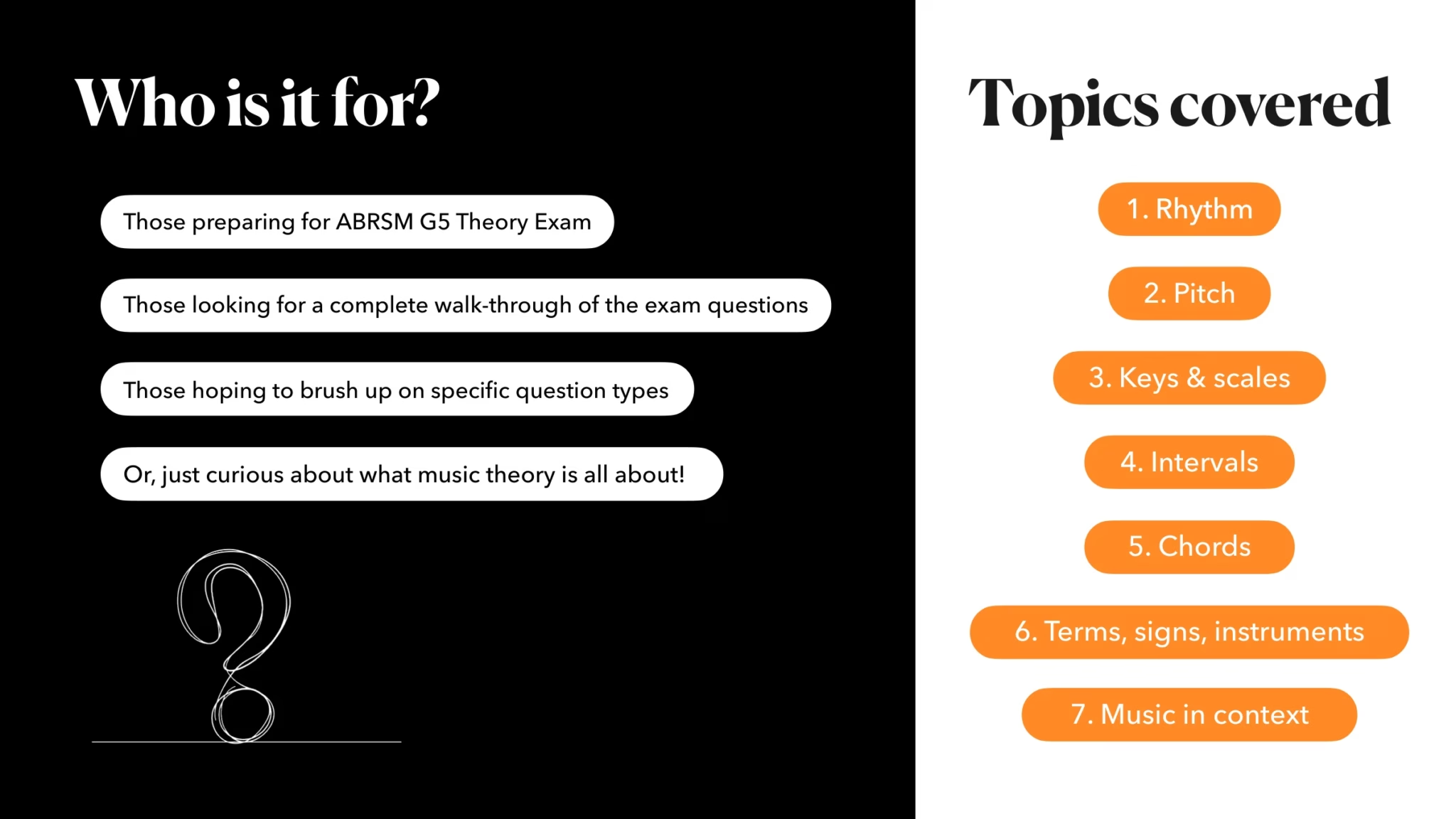
Here is the exact structure of the paper:
Section 1: Rhythm
This section tests your understanding of time signatures, note values, and rhythmic patterns. You may be asked to rewrite rhythms in different time signatures, add missing rests, or identify rhythmic errors.
Section 2: Pitch
Here, you’ll work with clefs (treble, bass, and sometimes alto or tenor), transposition, and note identification. Questions often involve rewriting a melody in a different clef or transposing it up or down by a given interval.
Section 3: Keys and Scales
You’ll need to demonstrate knowledge of major and minor scales (both harmonic and melodic), key signatures, and degrees of the scale. Be prepared to write out scales or identify key signatures from a given passage.
Section 4: Intervals
This section asks you to identify or write specific melodic and harmonic intervals. You’ll need to know not just the numerical size of the interval (e.g., 3rd, 5th) but also its quality (major, minor, perfect, augmented, diminished).
Section 5: Chords
You’ll work with triads and chords, often in the context of a given key. Questions may involve identifying chords as I, II, IV, or V, or writing out a chord progression in root position or first inversion.
Section 6: Terms, Signs, and Instruments
This is the theory and general knowledge section. You’ll be tested on Italian, French, and German performance directions, as well as orchestral instruments, their ranges, and transpositions. Memorisation is key here.
Section 7: Music in Context
The final section is an extended question based on a short piece of music. You’ll need to apply everything you’ve learned — rhythm, pitch, harmony, and terminology — to answer questions about the extract.
Why Knowing the Structure Matters
Many students use the official ABRSM textbooks such as the classic AB Guide to Music Theory to prepare, but these resources are often organised by topic rather than by exam format. That means you might study scales extensively, but when you sit down to take the actual paper, the questions appear in a different order and style than what you practised.
By familiarising yourself with the exam’s actual structure, you can:
- Manage your time more effectively during the test
- Identify your weaker sections and prioritise them in your revision
- Reduce anxiety by knowing exactly what comes next
How to Prepare for Each Section
Every section requires a slightly different approach:
- Rhythm and Pitch are about accuracy and fluency — regular practice with varied questions is key.
- Keys, Scales, and Intervals require a solid understanding of key signatures and the ability to visualise notes on the staff quickly.
- Chords demand an understanding of harmony within a key, so practising with real musical examples helps.
- Terms and Instruments is mostly memorisation, so flashcards or spaced repetition can be very effective.
- Music in Context is the most integrated section — it tests your ability to apply multiple skills at once, so doing full practice papers is the best preparation.
Practice Makes Progress
One of the biggest challenges students face is finding enough varied practice material. The same few examples can only take you so far. That’s why having access to a large bank of questions — especially ones that mirror the exam format exactly — is so valuable.
The best way to build confidence is to:
- Drill individual sections until you feel secure in each area.
- Take full timed papers to get used to the 2-hour time limit.
- Review your answers and understand where you went wrong.
Final Thoughts
The ABRSM Grade 5 Music Theory exam is challenging, but it’s also highly predictable. Once you understand its structure and the types of questions asked in each section, you can prepare strategically and avoid last-minute surprises.
Whether you’re taking the exam to unlock your Grade 6 practical, or simply to deepen your musical understanding, knowing the terrain is the first step to conquering it.
Ready to test your skills? Explore my interactive practice site at app.owenmusictheory.com! It covers every section of the exam, with Drill Mode for focused practice on specific question types and Exam Mode for a realistic timed exam experience. Questions are randomised and instant feedback helps you identify and improve your weak areas.

Get started
- Head to app.owenmusictheory.com
- Sign up free — no card required
- Try the free Pitch and Terms drills, or sit the free sample exam paper
- If it’s helping, upgrade for full access to every section and unlimited randomised papers
Grade 5 Theory is a one-time hurdle standing between you and your next practical grade. Practising smart — with realistic questions, instant feedback, and proper timed conditions — is the difference between walking in anxious and walking in ready. Good luck!